Launch offer — valid today only

📄 Digital book in PDF · read it on your phone or print it

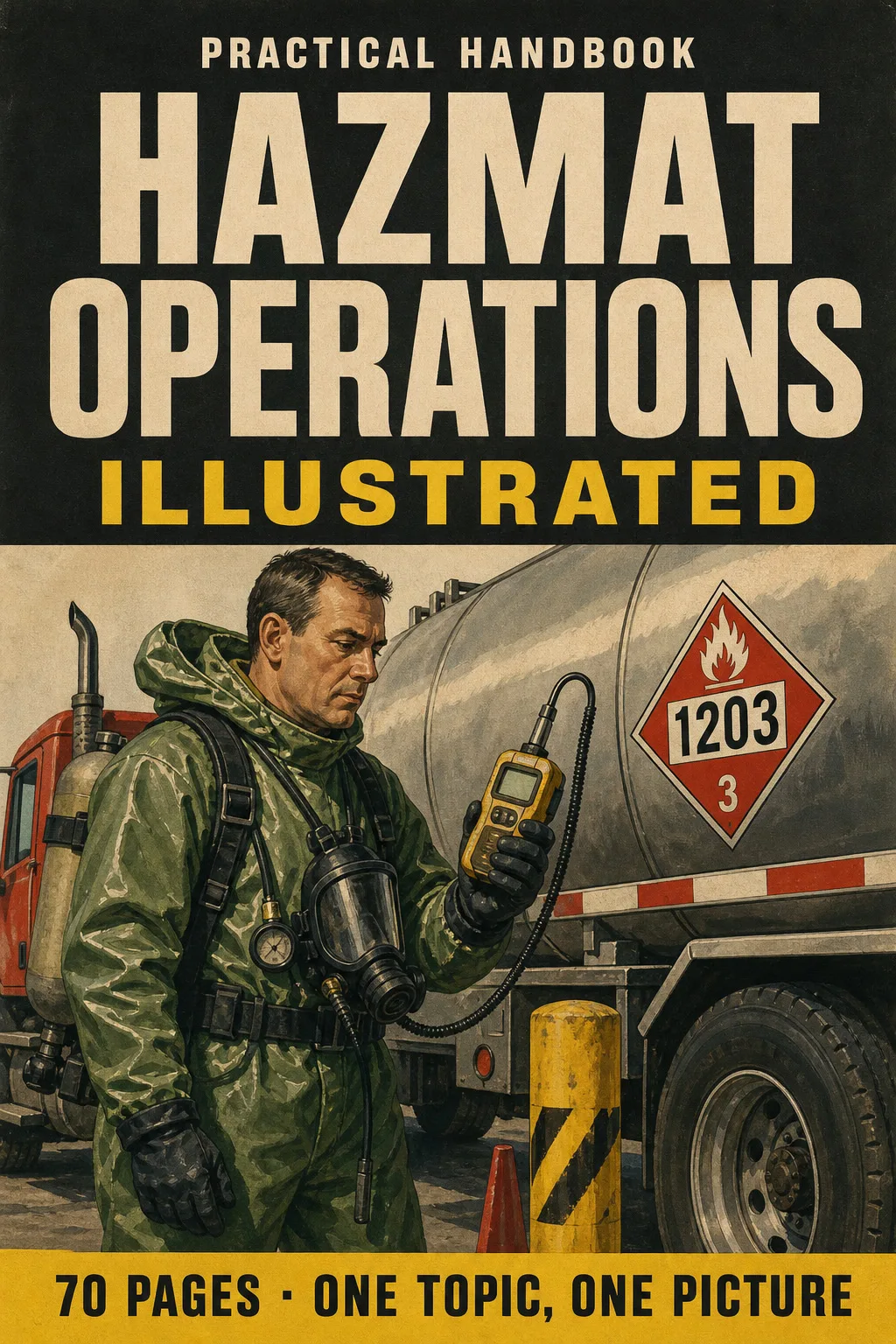
Hazmat Operations and NFPA 470 in Drawings Work Every Scene in the Same 6 Steps

Hazard classes and placards, cargo tanks and rail cars, the seven clues, the ERG color by color, TRACEMP, PPE Levels A to D, hot-warm-cold zones and the decon corridor. Every topic gets its own page: the drawing first, then what you need to remember. 70 illustrated pages.

START STUDYING THIS WAY

🔒 Secure checkout · PDF by email · 30-day guarantee

Every topic, its own pageEach placard, tank and scene step drawn, with the explanation right beside it
70 illustrated pages9 parts, from the NFPA 470 levels to the final field check
Up-to-date sourcesNFPA 470 (2022), ERG 2024 and 49 CFR 172–173
PDF by emailFormat

Look Inside the Book

Every page has one big drawing and a box with the codes, numbers and steps you need to know:

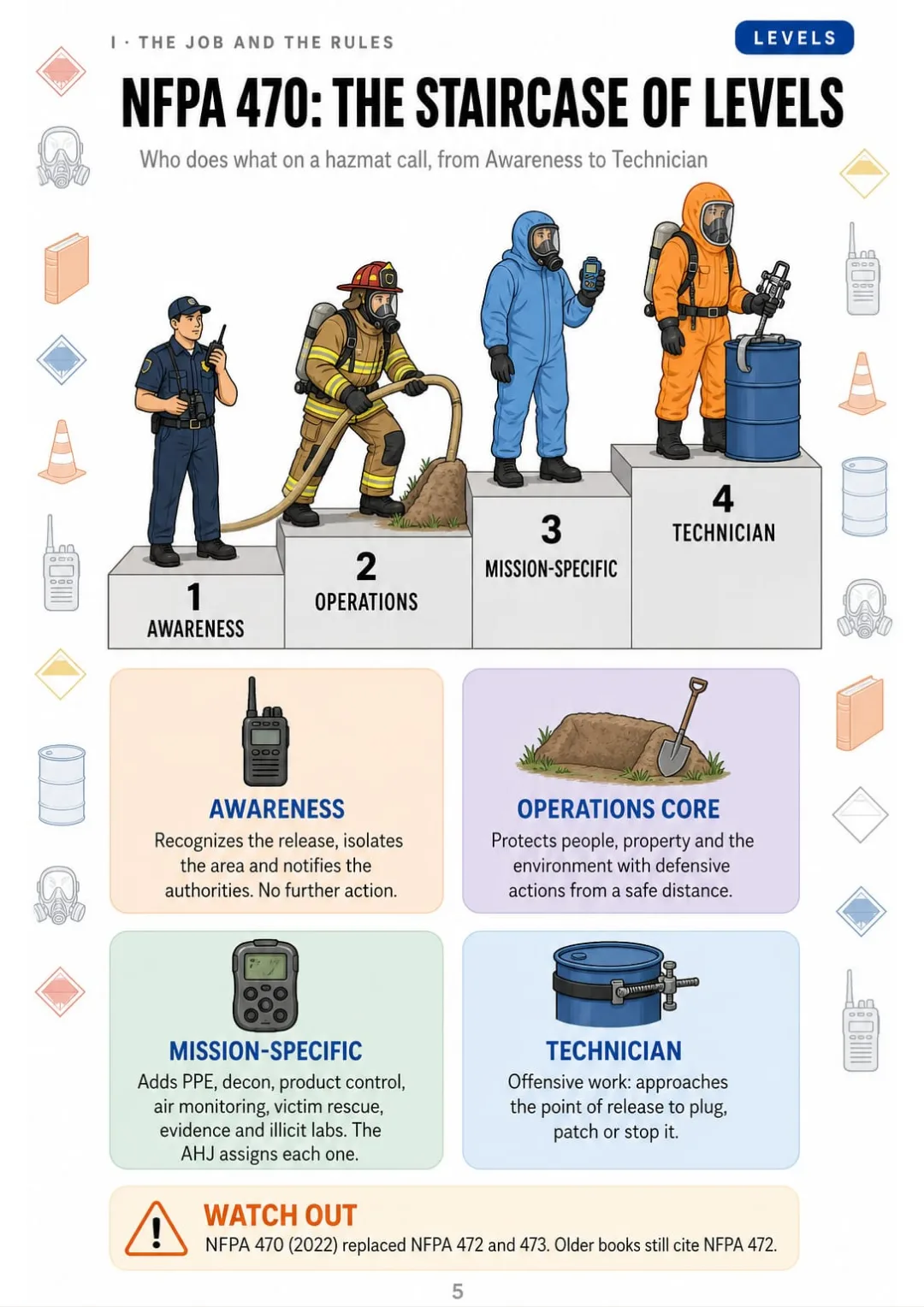
Awareness, Operations, Mission-Specific and Technician: one staircase, NFPA 470 (2022).
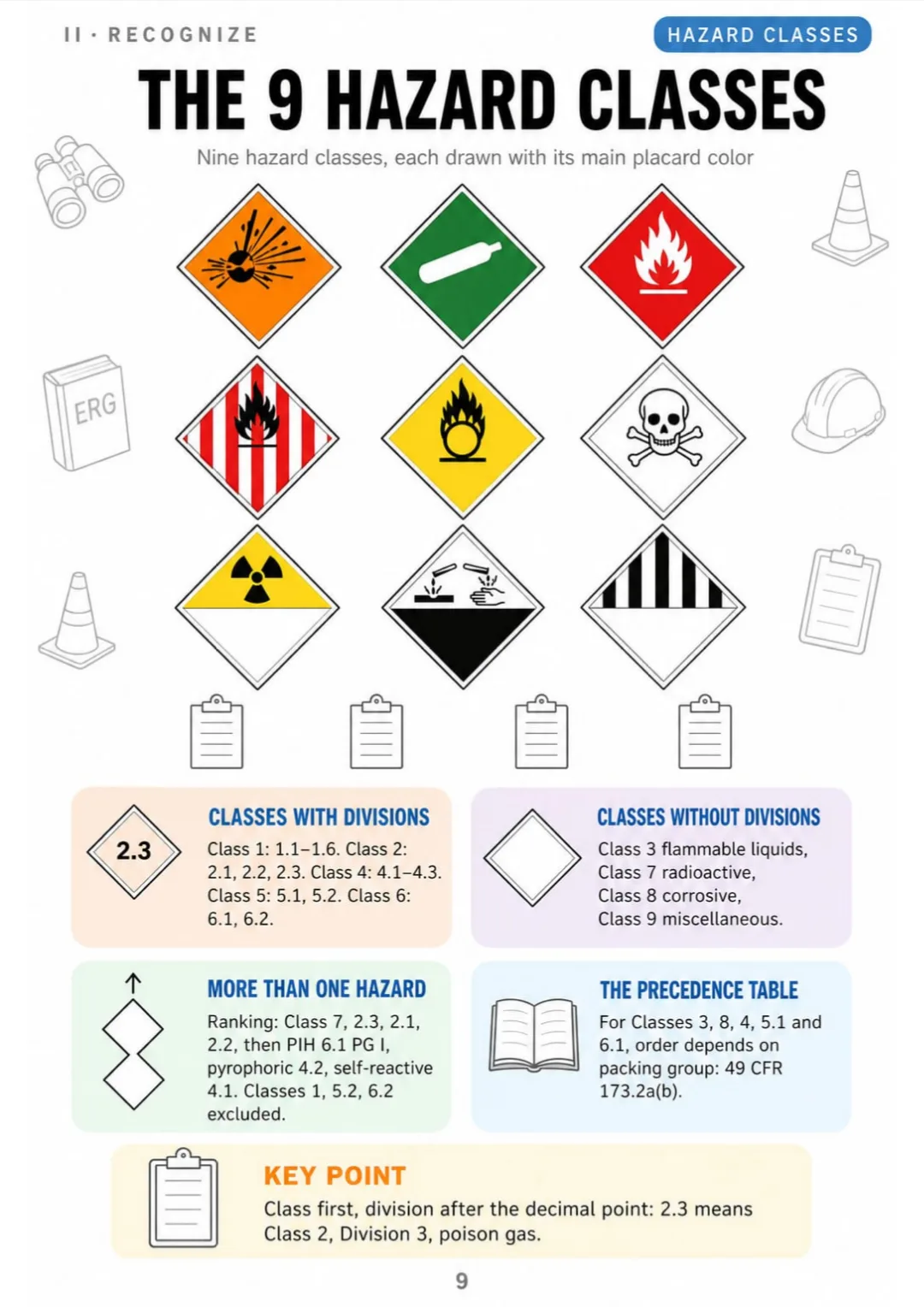
The 9 DOT hazard classes and their divisions, per 49 CFR 173.2 and 172.504
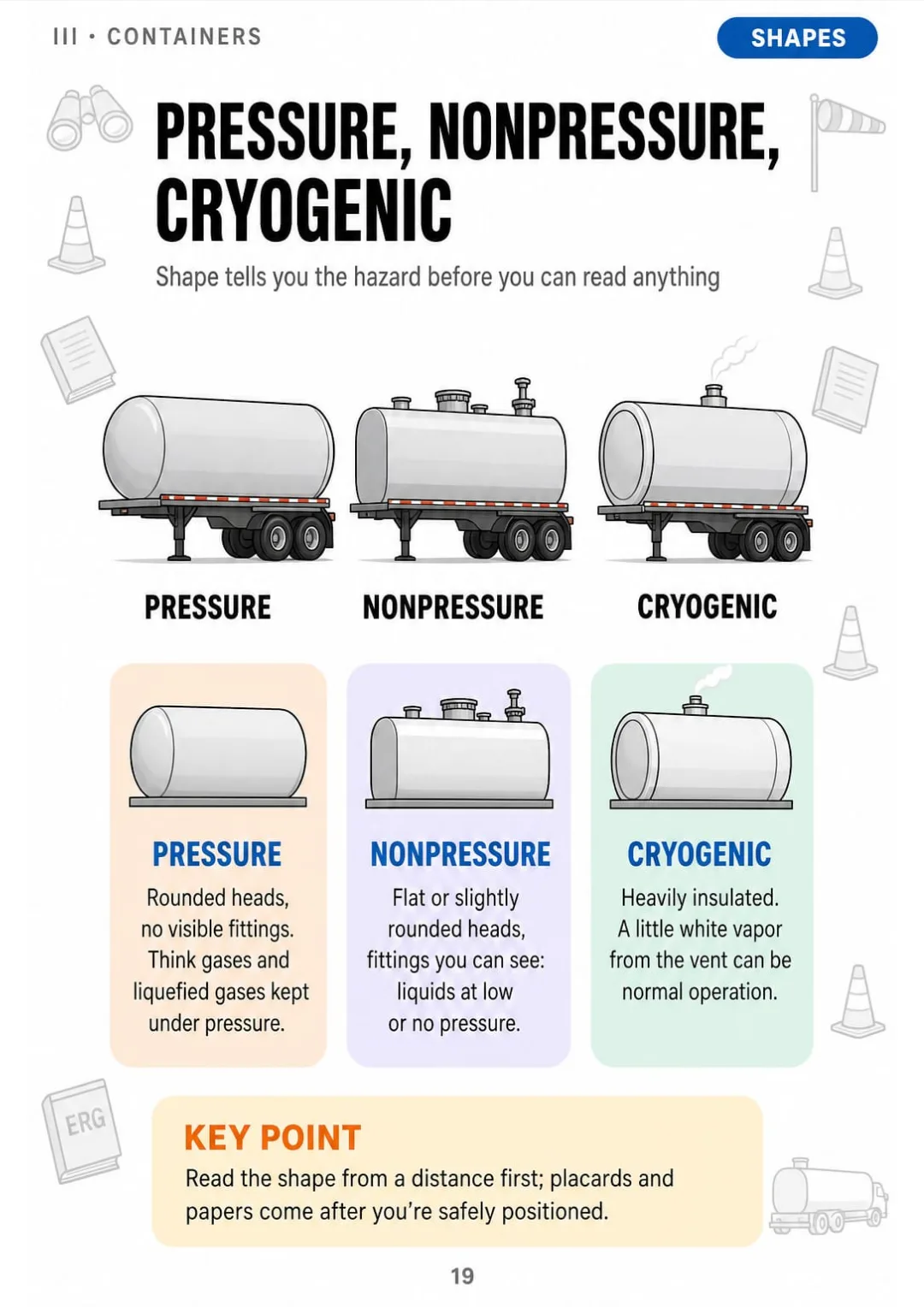
Rounded heads = pressure · visible fittings = nonpressure · insulated with vapor = cryogenic
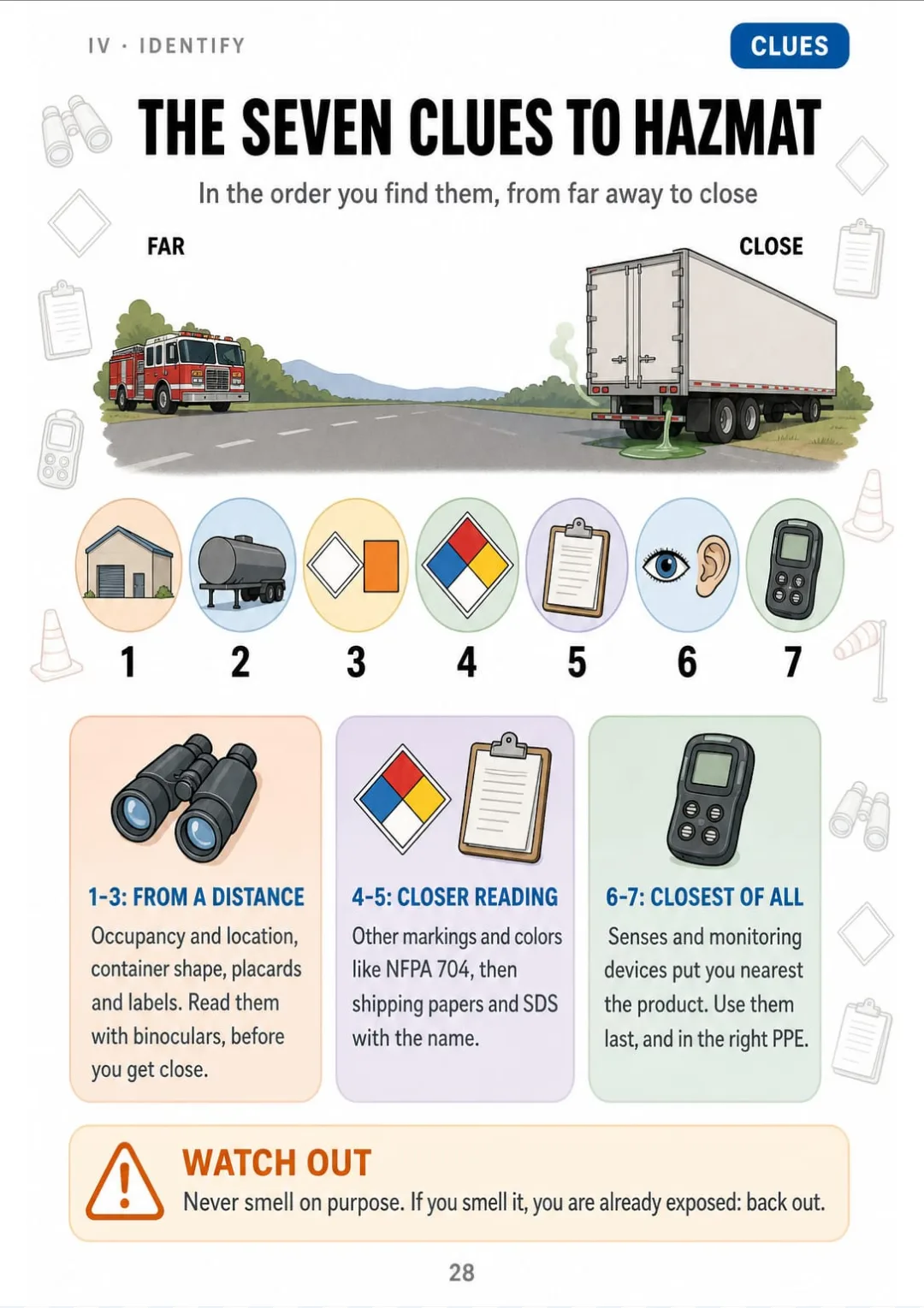
7 clues to hazmat: from occupancy (far) to monitoring devices (closest)
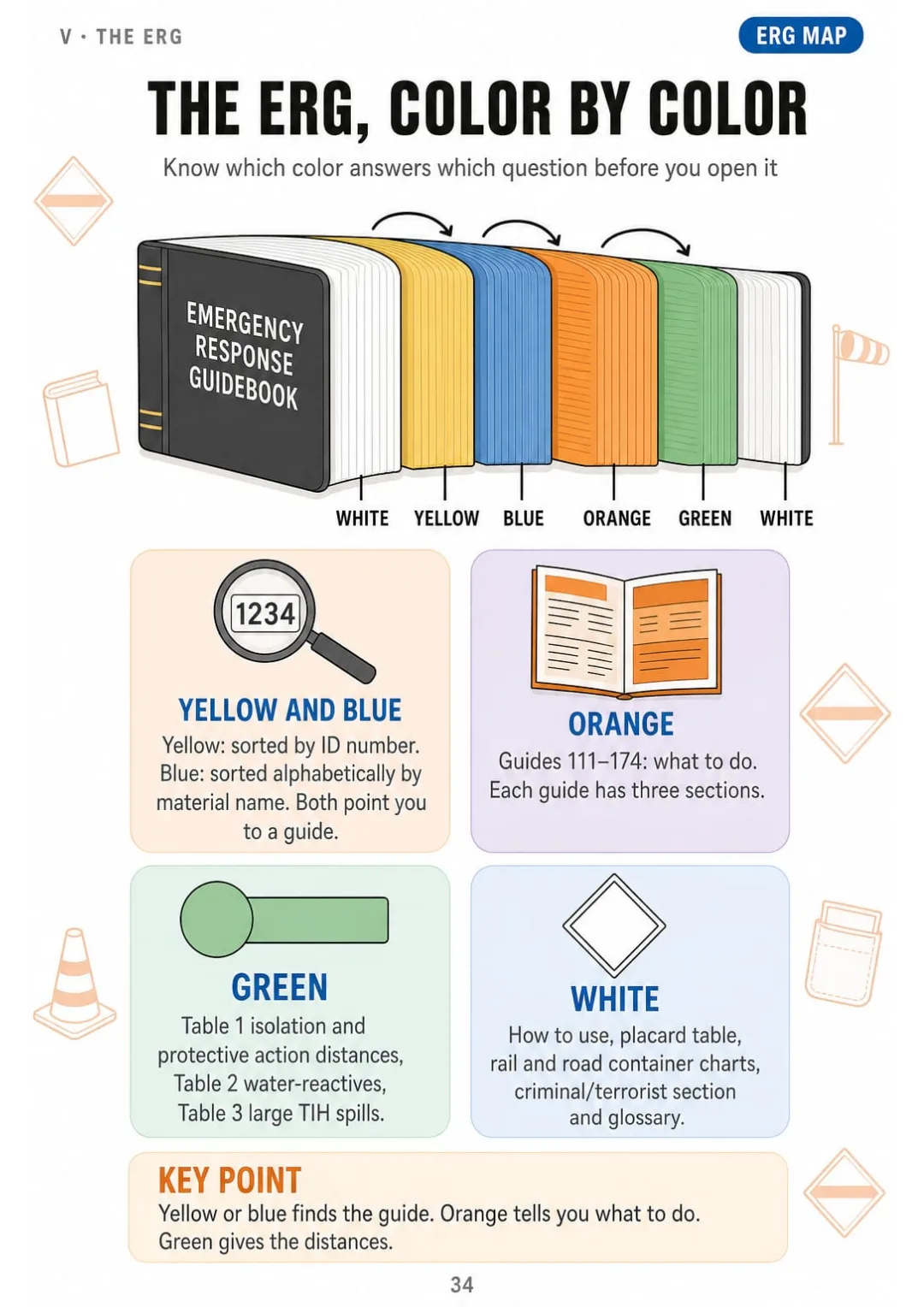
ERG2024: yellow by number, blue by name, orange Guides 111–174, green distance tables
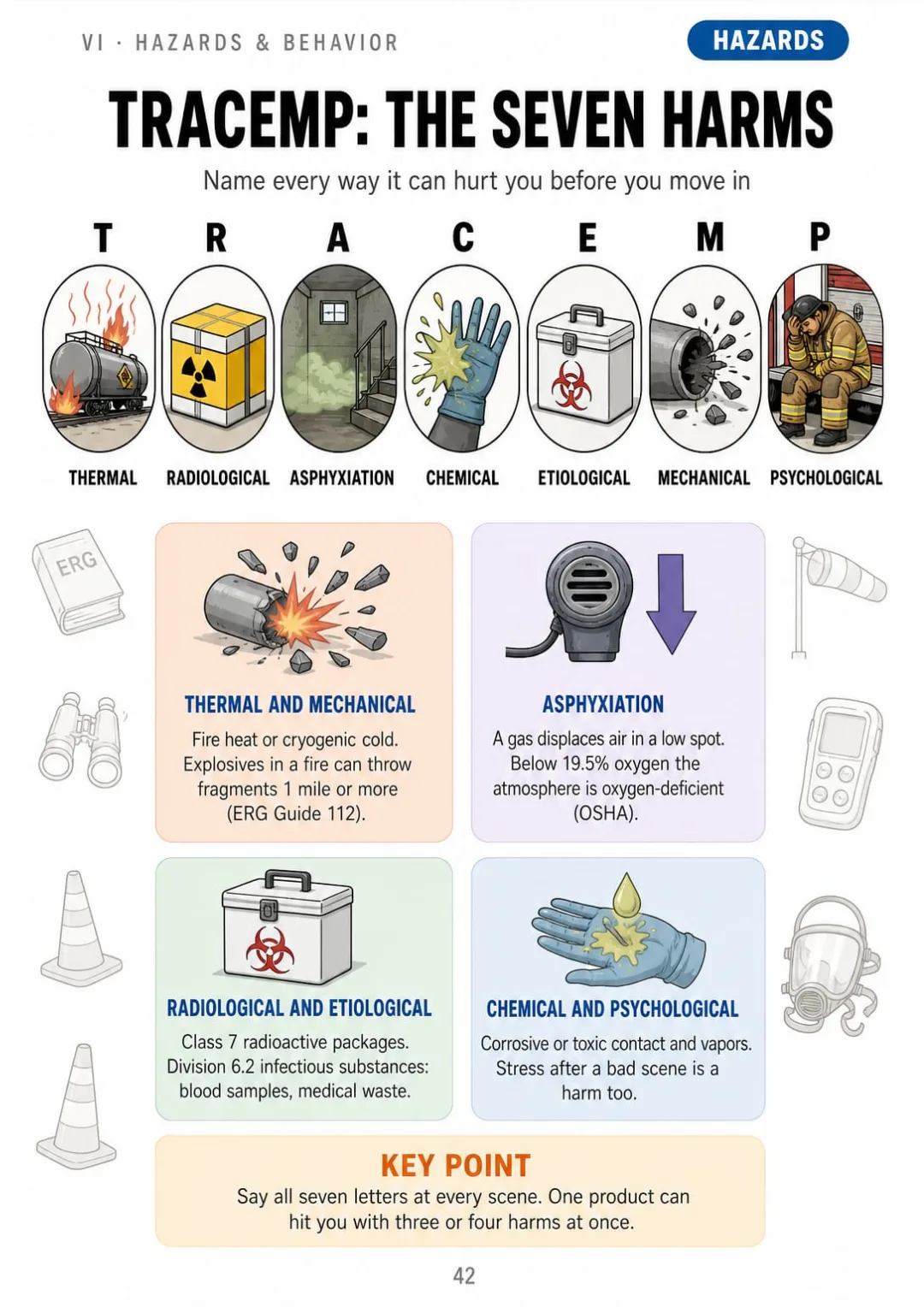
TRACEMP: thermal, radiological, asphyxiation, chemical, etiological, mechanical, psychological, each with a scene example
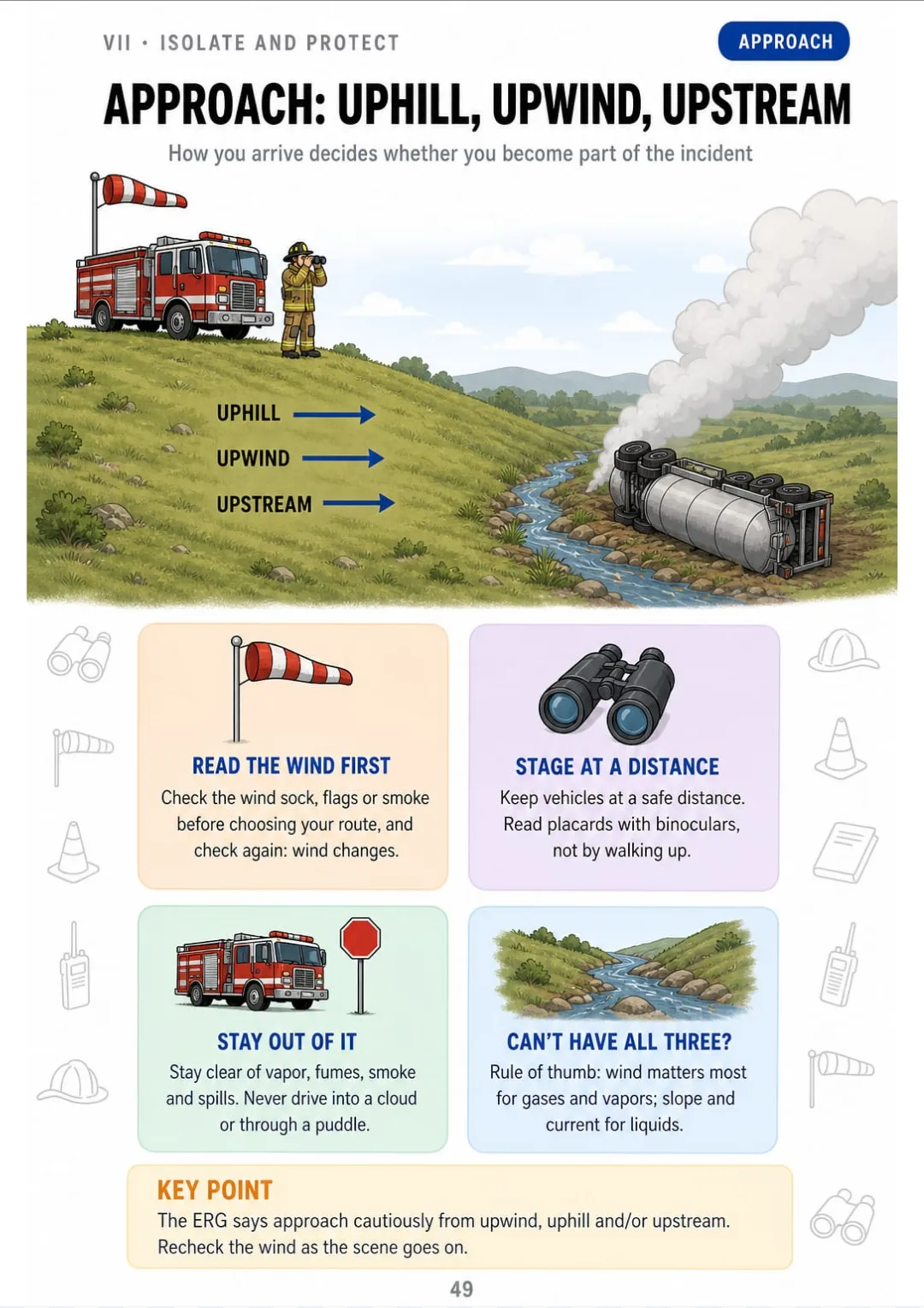
Upwind, uphill, upstream: the ERG approach rule, drawn from above with the wind sock.
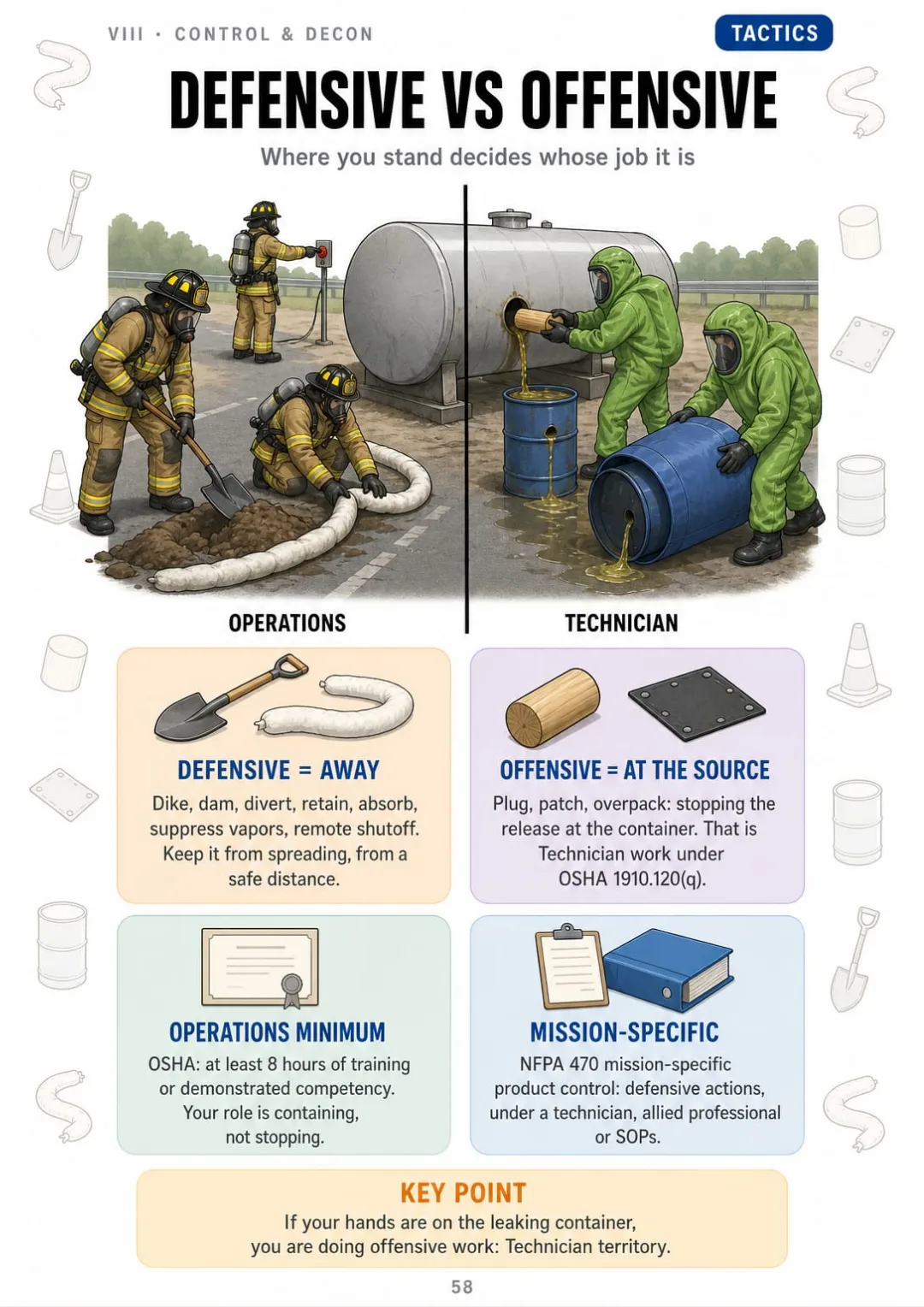
Defensive (dike, absorb, remote shutoff) vs offensive (plug, patch, overpack), per OSHA 1910.120(q)

Swipe to see more →

These are real pages from the book. The table of contents is the full one: 9 parts and 66 topics.

The Problem Isn't You. It's How It Was Explained to You.

You're first-due on the interstate. A tank trailer is on its side, and from the cab you need to know one thing: is it under pressure or not?

The manual covers it in dense paragraphs about design pressures, tank heads and fittings. Read that way, it doesn't come back to you at 2 a.m. on the shoulder.

Rounded heads = pressure · visible fittings = nonpressure · insulated with vapor = cryogenic

In the book it's one page: the tank trailers drawn side by side. Rounded heads mean pressure (MC-331). An oval shell means nonpressure (MC-306). A thick insulated shell, like a thermos, means cryogenic (MC-338).

The same goes for the 9 hazard classes, the seven clues, the ERG's four colors, TRACEMP and defensive versus offensive actions: each one has its own page.

You look at the silhouette, you know what you're dealing with, and you make the call without going back to the manual.

COMPARE FOR YOURSELF

Same Topic, Two Ways to Study It

THIS
  • The manual: line after line after line
  • Hazard classes explained only in words
  • You walk into the exam still unsure
Hazardous materials in transportation are assigned to one of nine hazard classes pursuant to 49 CFR 173.2, several of which are further subdivided into divisions. Class 1 comprises explosives, divided into Divisions 1.1 through 1.6; Class 2 comprises gases, divided into Divisions 2.1, 2.2 and 2.3; Class 3 comprises flammable liquids; Class 4 comprises flammable solids, spontaneously combustible materials and dangerous-when-wet materials; Class 5 comprises oxidizers and organic peroxides; Class 6 comprises poisonous and infectious substances; Class 7, radioactive materials; Class 8, corrosives; and Class 9, miscellaneous hazardous materials.
FOR THIS
  • All 9 hazard classes in one drawing
  • The divisions in a box beside each placard
  • You see it and you get it
The 9 DOT hazard classes and their divisions, per 49 CFR 173.2 and 172.504
CONTENTS

Take a Look at the 9 Parts and 66 Topics

The job and the rules, hazard classes and placards, containers by shape, identification clues, the ERG step by step, how products behave, isolation and PPE, control and decon, and a final field check: 70 pages, all illustrated.

IThe Job and the Rules · pp. 5-8
  1. NFPA 470: Awareness, Operations, Technician
  2. Who Requires Your Training
  3. What Operations Can and Can't Do
  4. The Scene Sequence This Book Follows
IIRecognize: Hazard Classes and Placards · pp. 9-18
  1. The 9 Hazard Classes on One Page
  2. Reading a Placard: Color, Symbol, Number
  3. Class 1 and Class 2, Division by Division
  4. Class 3: Flammable vs Combustible
  5. Class 4 and Class 5: The Look-Alikes
  6. Class 6, 7, 8 and 9
  7. When a Truck Must Be Placarded
  8. The DANGEROUS Placard and Mixed Loads
  9. Markings That Aren't Placards
  10. NFPA 704 and GHS Pictograms
IIIRecognize: Containers by Shape · pp. 19-27
  1. Pressure, Nonpressure, Cryogenic
  2. MC-306 / DOT-406: The Gasoline Tank
  3. MC-307 / DOT-407: The Chemical Hauler
  4. MC-312 / DOT-412: The Corrosives Tank
  5. MC-331, MC-338 and Tube Trailers
  6. Rail Tank Cars
  7. Reading Rail Car Stencils
  8. Drums, Bags, Totes and Cylinders
  9. Intermodal Tanks and Pipelines
IVIdentify: Papers, Clues and Senses · pp. 28-33
  1. The Seven Clues to Hazmat
  2. Shipping Papers by Mode
  3. The Basic Description, in Order
  4. Occupancy and Location Clues
  5. Your Senses and the Victims
  6. Criminal and Terrorist Incidents
VThe ERG Step by Step · pp. 34-41
  1. The ERG as Four Colors
  2. Yellow Pages: Start With the Number
  3. Blue Pages: When You Only Have the Name
  4. No Number, No Name: White Pages
  5. Orange Pages: The Three Sections
  6. Initial Isolation in the Orange Pages
  7. Green Pages: Isolation Plus Protective Action
  8. Green Tables 2 and 3
VIHazards and How Products Behave · pp. 42-48
  1. TRACEMP: The Seven Harms
  2. Vapor Density and Specific Gravity
  3. Flash Point, Ignition and Flammable Range
  4. Vapor Pressure, Boiling Point, Solubility
  5. Routes of Entry and Exposure Limits
  6. The Hazmat Behavior Model
  7. Dispersion Patterns
VIIIsolate and Protect · pp. 49-57
  1. Approach: Uphill, Upwind, Upstream
  2. Hot, Warm and Cold Zones
  3. Protect in Place vs Evacuate
  4. Levels of PPE: A, B, C, D
  5. Structural Turnouts: What They Don't Do
  6. Respiratory Protection
  7. Reading a Four-Gas Monitor
  8. Buddy System, Backup Team, Medical Monitoring
  9. ICS on a Hazmat Scene
VIIIControl and Decontaminate · pp. 58-65
  1. Defensive vs Offensive
  2. Dikes, Dams and Diversion
  3. Absorption, Adsorption and Dilution
  4. Vapor Suppression and Dispersion
  5. Remote Shutoffs and Emergency Valves
  6. Decon Methods
  7. The Decon Corridor, End to End
  8. Mass Decon: Ambulatory and Nonambulatory
IXReview and Field Check · pp. 66-70
  1. The Whole Scene on One Page
  2. The Numbers to Know
  3. Acronyms on One Page
  4. The Look-Alikes, Side by Side
  5. The Most Common Scene Mistakes

One Page, One Topic, All Clear

Think of it this way:

Drill night. The training officer reads out "UN 1203, wind out of the west," and the whole crew waits for you to say where to stage.

You've already seen it on one page: the ERG drawn as a color path, yellow by number, blue by name, orange for the guide, green for the distances, in the order you use it. You stage uphill and upwind, and you know why.

ERG2024: yellow by number, blue by name, orange Guides 111–174, green distance tables

Same with placards, cargo tank silhouettes, PPE Levels A to D, the hot-warm-cold zones and the decon corridor: each one on its own page.

Hazmat Operations Illustrated is 9 parts and 66 topics, all drawn, and it closes with a review section: the numbers to know, the acronyms and the look-alikes side by side.

What you see drawn, you don't have to memorize.

What's Inside Hazmat Operations Illustrated:

Ipp. 5-8

The Job and the Rules

The NFPA 470 levels, who requires your training, what Operations can and can't do, and the scene sequence the whole book follows.

IIpp. 9-18

Recognize: Hazard Classes and Placards

The 9 hazard classes, how to read a placard, each class division by division, when a truck must be placarded, the DANGEROUS placard, other markings, NFPA 704 and GHS.

IIIpp. 19-27

Recognize: Containers by Shape

Pressure, nonpressure and cryogenic, the MC-306, MC-307, MC-312, MC-331 and MC-338, tube trailers, rail tank cars and stencils, drums, totes, cylinders and pipelines.

IVpp. 28-33

Identify: Papers, Clues and Senses

The seven clues to hazmat, shipping papers by mode, the basic description in order, occupancy clues, your senses and criminal incidents.

Vpp. 34-41

The ERG Step by Step

The ERG as four colors: yellow by number, blue by name, white pages, the three orange sections, initial isolation and the green tables.

VIpp. 42-48

Hazards and How Products Behave

TRACEMP, vapor density, specific gravity, flash point and flammable range, vapor pressure, routes of entry, the behavior model and dispersion patterns.

VIIpp. 49-57

Isolate and Protect

Uphill, upwind, upstream, the three zones, protect in place vs evacuate, PPE Levels A to D, turnouts, respiratory protection, the four-gas monitor and ICS.

VIIIpp. 58-65

Control and Decontaminate

Defensive vs offensive, dikes and dams, absorption and adsorption, vapor suppression, remote shutoffs, decon methods, the decon corridor and mass decon.

IXpp. 66-70

Review and Field Check

The whole scene on one page, the numbers to know, the acronyms, the look-alikes side by side and the most common scene mistakes.

At the end of the book: A review section with the numbers to know, the acronyms on one page and the look-alikes side by side, plus exam-style practice questions with answers.
Plus: 2 Free Books

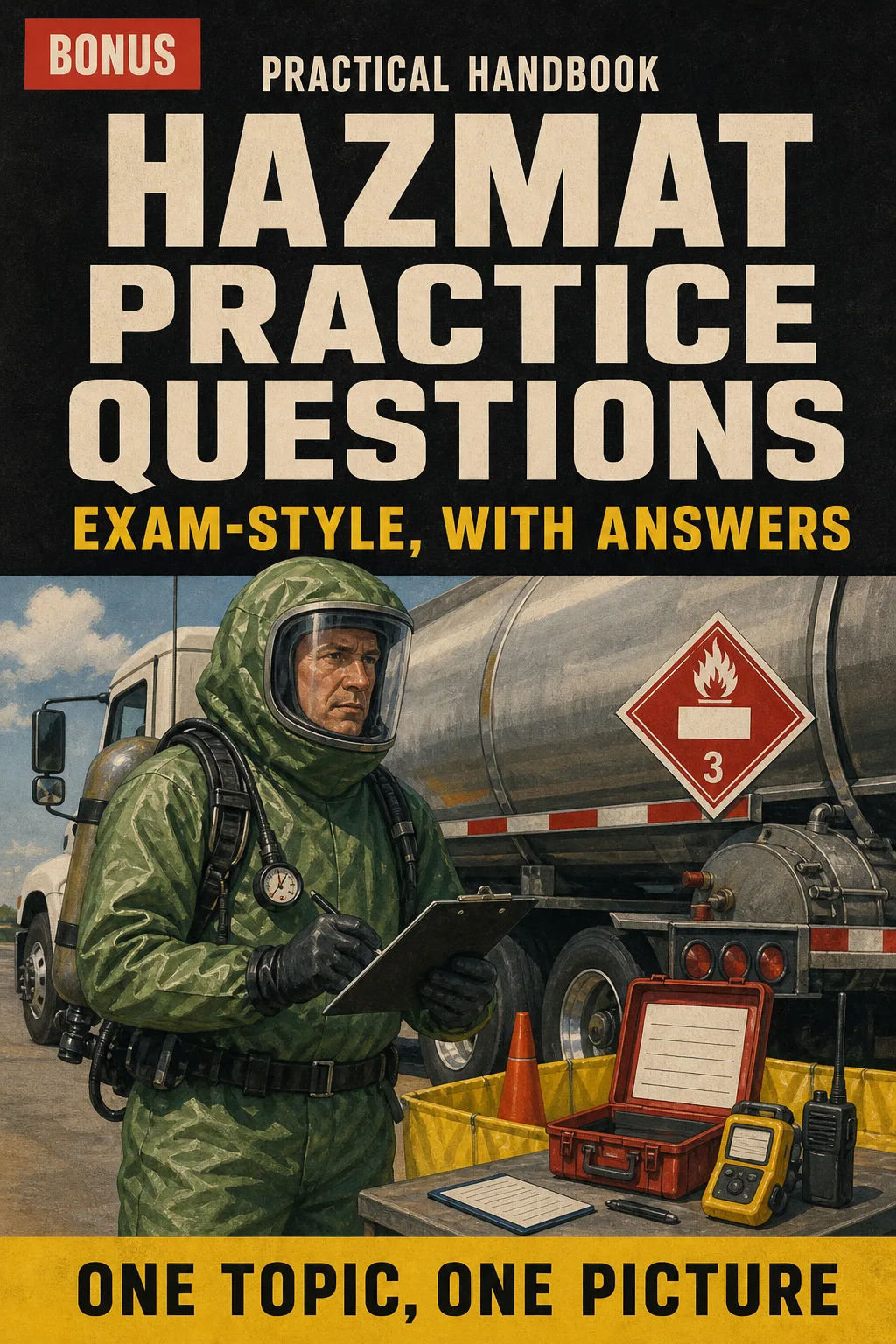
Hazmat Practice Questions: Exam-Style, with Answers

BONUS 1: «Hazmat Practice Questions: Exam-Style, with Answers»

Value on its own: US$ 17.90

Test yourself on placards, containers, the ERG, PPE and decon, and read why each answer is right, so you find your weak spots before exam day.

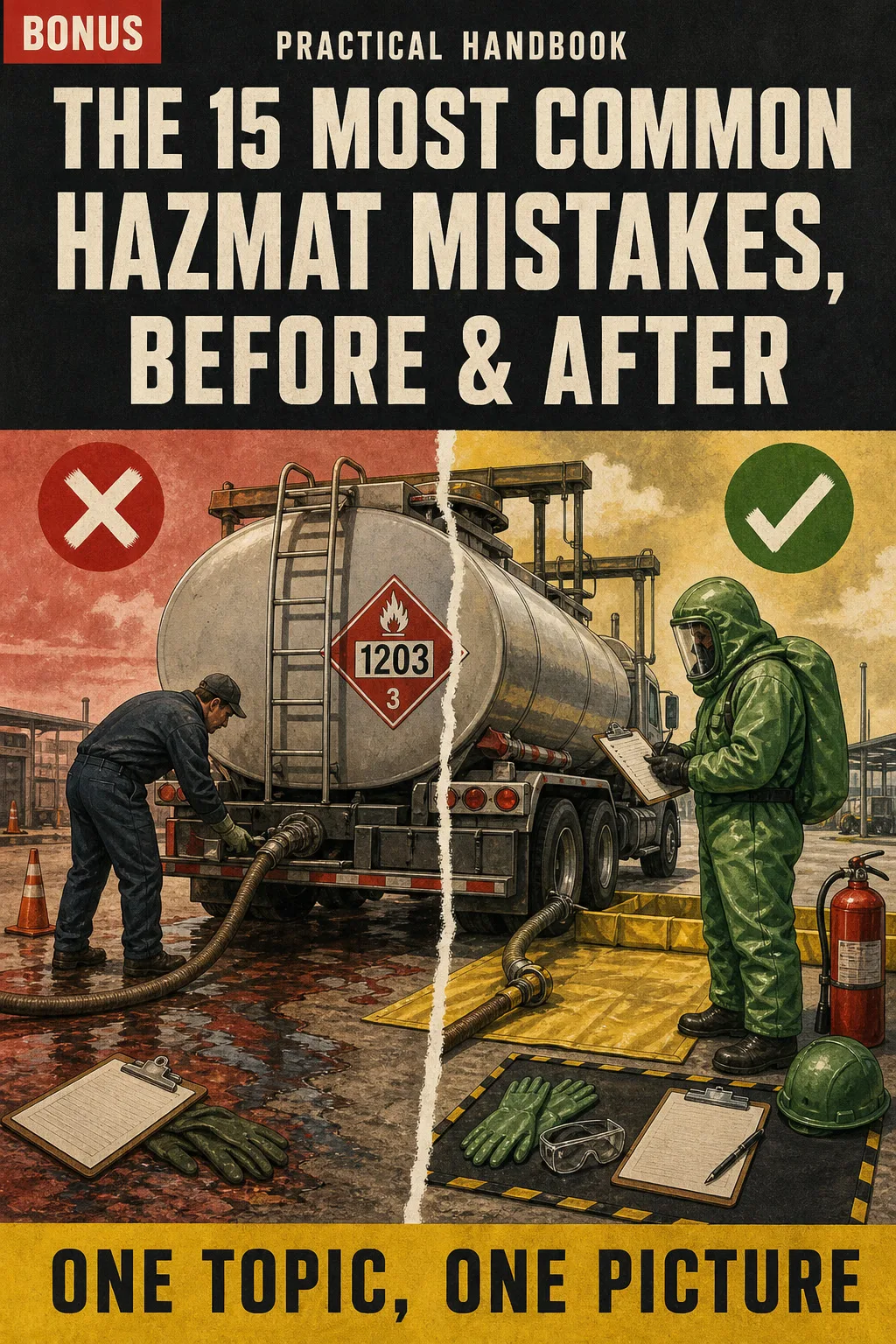
The 15 Most Common Hazmat Mistakes, Before & After

BONUS 2: «The 15 Most Common Hazmat Mistakes, Before & After»

Value on its own: US$ 14.90

See the errors responders make most often, from staging downwind to skipping the ERG's green pages, each drawn wrong and then right, for a quick review the night before.

Hazmat Operations Illustrated with 2 Free Books

  • Hazmat Operations Illustrated: 70 illustrated pagesUS$ 63
  • BONUS 1: Hazmat Practice Questions: Exam-Style, with AnswersUS$ 17.90
  • BONUS 2: The 15 Most Common Hazmat Mistakes, Before & AfterUS$ 14.90
  • High-resolution PDF to printIncluded
Total value US$ 95.80
YOUR PRICE:
US$ 27
You save US$ 68.80
YES, I WANT HAZMAT OPERATIONS ILLUSTRATED FOR US$ 27

📄 This is a digital PDF book sent to your email: nothing is printed or shipped.

Secure purchaseEncrypted payment30-day guarantee

PDF by email: We email you Hazmat Operations Illustrated as a PDF, together with the two free books. It's a single payment: no installments, no extra charges.

Who This Book Is For

You're studying for Hazmat Ops

You're studying for Hazmat Ops

Between shifts or after your day job, you go one page at a time, in the same order you'll work a scene: recognize, identify, isolate, protect, control, decon.

Your exam or recert is coming up

Your exam or recert is coming up

The review section and the practice questions show you where you're weak, and the night before you flip through the drawings instead of the whole manual.

You're already on the job or on a plant ERT

You're already on the job or on a plant ERT

You print the pages you need, keep them in the rig or the response room, and check a placard, a tank shape or the decon line at a glance.

Everything You Get Today

US$ 95.80US$ 27
YES, I WANT HAZMAT OPERATIONS ILLUSTRATED FOR US$ 27

📄 This is a digital PDF book sent to your email: nothing is printed or shipped.

30DAYS
GUARANTEE

30-Day Guarantee

Try Hazmat Operations Illustrated for 30 days, bonus books included.

We refund everything if the file won't open, if the book isn't what you see here, if you were charged twice or if the email doesn't arrive. Just email us.

You pay once. No subscriptions.

Frequently Asked Questions

Is this for me if I'm a firefighter studying for Hazmat Operations between shifts?

Yes. It's written for career and volunteer firefighters and plant ERT members working toward Awareness or Operations, or renewing it. It goes up to Operations level, one topic per page, in the order you work a scene. It doesn't cover Technician level: if you're going for Technician, use it as a review of the Ops foundation.

Where does the content come from?

From NFPA 470 (2022 edition), the Emergency Response Guidebook 2024 (U.S. DOT/PHMSA), 49 CFR Parts 172–173 and OSHA 29 CFR 1910.120(q). Every code and value is checked against those current editions.

Is this official material?

No. It's an independent illustrated study book, not published or endorsed by NFPA, DOT/PHMSA, OSHA, the Pro Board, IFSAC or any certifying body. Pro Board and IFSAC accredited programs certify to the NFPA standard, so the book follows the NFPA 470 Awareness and Operations competencies. It doesn't cover state-specific rules or your department's SOPs: check your state's exam outline.

Does it replace my academy course or department training?

No. It helps you study and review. It doesn't replace your official training, your department's protocols or the ERG you carry on scene, and it doesn't give you a certificate or CE hours.

Are the practice questions the ones on the exam?

No. They're written for this book, in exam style, with the answer explained. They aren't official questions from any exam.

When and how do I get it?

The book and the 2 bonus books arrive as PDFs by email, at the address you enter at checkout.

Do I have to pay every month?

No. It's a one-time payment. No subscription.

Can I have it on paper?

Yes. The PDF is made to print: print the whole book or just the pages you want to keep in the rig.

How does the refund work?

You have 30 days. We refund everything if the file won't open, if the book isn't what you see on this page, if you were charged twice or if the email doesn't arrive: just email us.

Before You Close This Page

No more rereading the manual with nothing sticking.

A placard or a tank silhouette: you see it drawn, and you know.

You walk into the exam and onto the scene knowing where everything is.

Drawings make studying faster.

The book is right below.

One-time payment: US$ 27 · Guarantee: 30 days · PDF by email

YES, I WANT HAZMAT OPERATIONS ILLUSTRATED FOR US$ 27

📄 This is a digital PDF book sent to your email: nothing is printed or shipped.